The Racebox B58TU Tuning Guide
If you own a B58TU powered BMW - whether that's an M240i, M340i, M440i, 540i, X3/X4 M40i, or a Toyota Supra (or an X5!) - you're sitting on one of the best tuning platforms BMW has ever made. The B58TU replaced the already-excellent Gen 1 B58, and it responds to modifications like nothing else in its class. This guide is built from years of hands-on tuning and wrenching experience at Racebox, and it's going to walk you through exactly how to make real, reliable power with your car.
We're not going to throw inflated dyno numbers at you. Everything in this guide is based on what we see on our dyno, with real cars, real fuel, and real results. That matters, and we'll explain why.

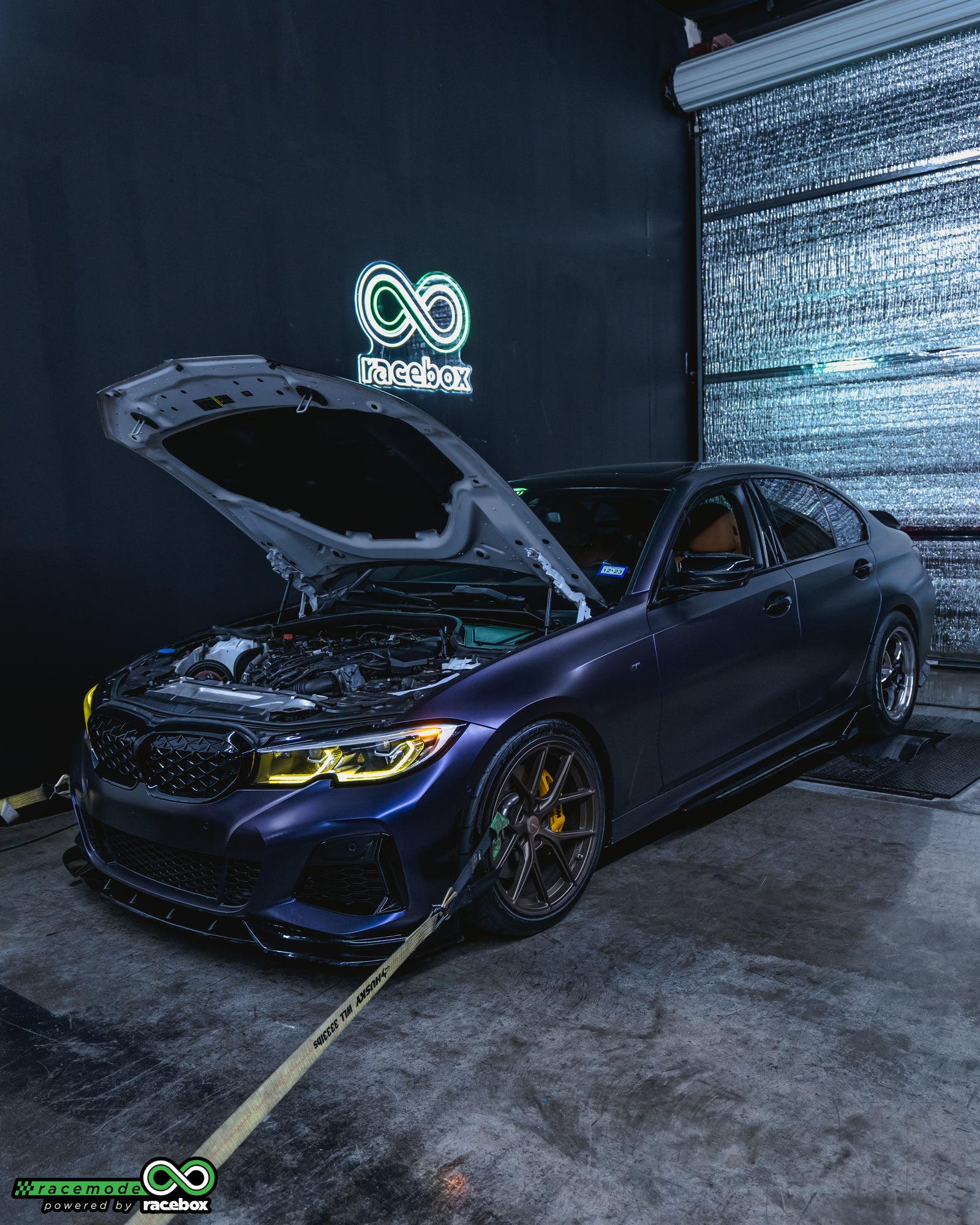
BMW M340i B58TU on Racebox dyno

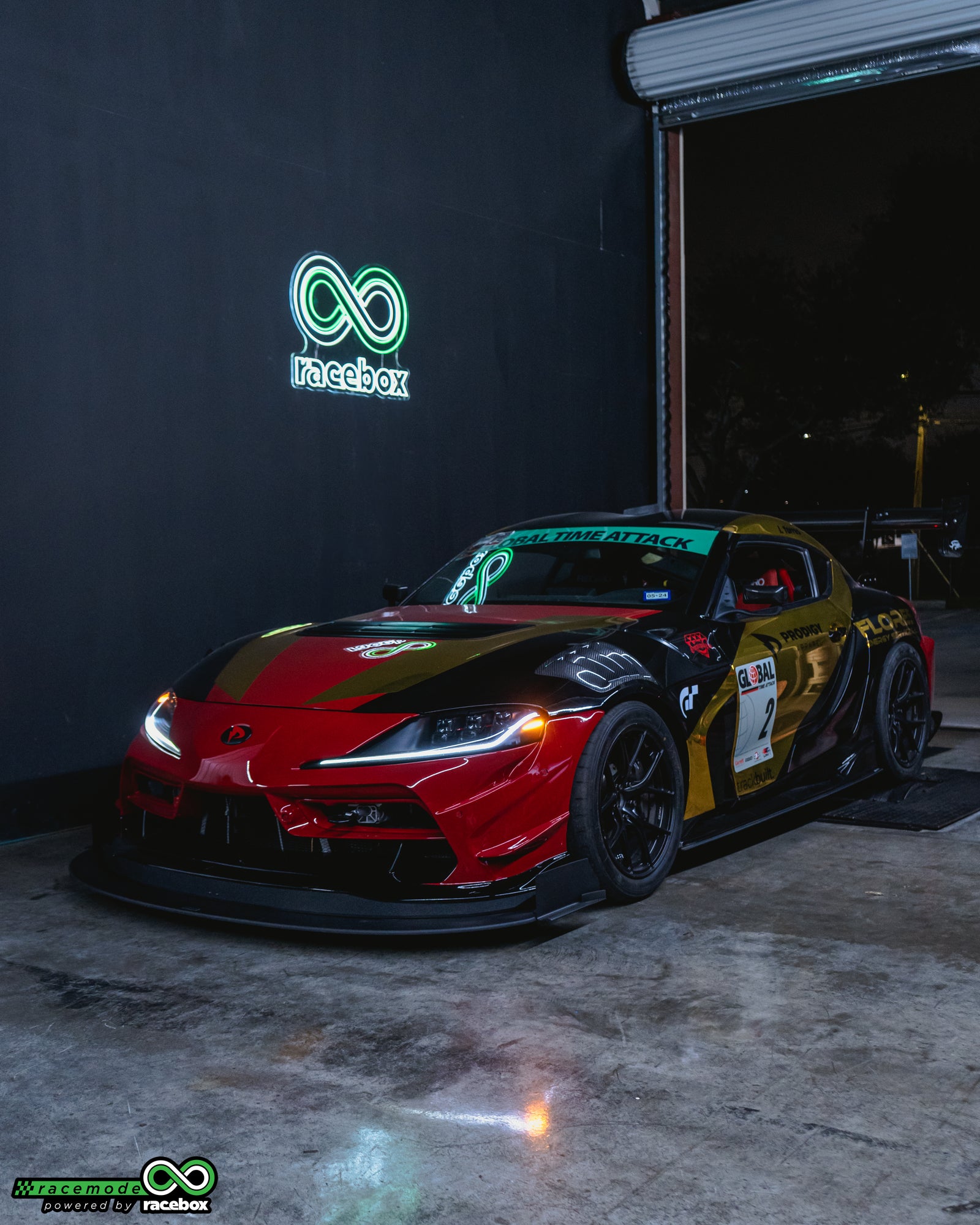
Troy's Supra A90 PTE 6466 build at Racebox
A Word on Dyno Numbers
Before we get into the builds, we need to talk about dyno numbers because this is where the tuning industry loves to mislead people.

Racebox DynoJet screen showing B58TU power curves
Not all dynos read the same. Some dynos read higher than others. Some have adjustable correction factors that allow you to make the dyno read high OR low (Mustang Dynos and most Hub Dynos). Even two Dynojets can read wildly different numbers based on the ambient conditions and elevation, as the SAE and STD correction factors were developed for NA cars, not modern turbocharged vehicles. The numbers you see from different tuners are often measured on different equipment, which makes direct comparisons meaningless unless you're looking at the delta from baseline. That's the only number that matters: how much did the car gain over stock on the same dyno, same day, same conditions?
We've seen competitors advertise "550whp on stock turbos" for the B58TU. Sounds impressive until you realize their bone stock baseline is showing 400+ whp. That's not a 550whp car, it's just a generous dyno with a 150whp gain, which is exactly the same as a car that makes 500whp with a 350whp baseline. On our dyno, a stock B58TU puts down 320–370whp depending on the model, and our tune numbers are measured against that honest baseline. When we tell you a number, it's real.
So when you're comparing tuners, don't compare peak numbers across different shops. Compare the gain over stock. That's where the truth lives.
Stock Baseline: Know What You're Starting With
The B58TU doesn't make the same power across every model. The biggest factor is whether you have a 2-port or 6-port head, as the DME calibration for the 6-ports is more aggressive from factory.
| Configuration | Models | Stock WHP (Racebox Dyno) |
|---|---|---|
| 2-port | X5 40i, X7 40i, 2-port Supra | 320–340 whp |
| 6-port | M240i, M340i, M440i, 540i, X3 M40i, X4 M40i, 6-port Supra | 350–370 whp |
In practice, we've seen that both attain the same results when tuned with similar mods. Differences in flow only become apparent and restrictive when we exceed 850whp with 6-ports making more power with less boost on larger setups up top.
These are your starting numbers. Everything we talk about below is measured as gains on top of these baselines, on our Dynojet.
The basics: Downpipe + Tune (Where Everyone Should Start)

B58 downpipe installation at Racebox
This is the single best modification you can do to a B58TU. A quality catless or catted downpipe paired with a B58 tuning from Racebox is where the B58TU really wakes up. The factory downpipe is restrictive and is the single biggest bottleneck in the exhaust system, and replacing it with a higher flowing aftermarket setup lets the turbo spool faster and breathe significantly better. Most BMW cat-backs are around 2.75 in from the factory and thus a full aftermarket exhaust is not necessary for power on stock turbos.
93 Octane Downpipe + Tune
On 93 octane pump gas with a downpipe and our custom tune, expect:
That's a gain of roughly 60-100whp over stock depending on your model and baseline. The 2-port cars see the bigger percentage gain since they're starting lower, but the 6-port cars hit higher peak numbers. The midrange pull is where you'll notice it most. The turbo comes on harder, stays on longer, and the car just doesn't run out of breath the way it does stock.
This is the stage where most people new to modifying their cars should live. It's reliable, it's repeatable, and it makes the car genuinely fast without stressing anything beyond what the factory hardware can handle. The stock turbo, stock fuel system, and stock intercooler are all perfectly happy at this power level on 93. New to all this? Read our Car Tuning 101 guide first for a primer on what a tune actually does.
E40 Blend Downpipe + Tune

MHD CAN FlexFuel Analyzer installed on BMW B58
If you have access to ethanol and are running an E40 blend (roughly 40% ethanol, 60% gasoline), the B58TU responds extremely well. Ethanol has a higher octane rating and better charge cooling properties, which means we can run more timing and more boost safely.
This is still on the stock turbo, and stock fuel system with just two mods: a downpipe and ethanol content analyzer (ECA), paired with our custom calibration. The spread in numbers comes down to the health of the motor, the condition of the turbos, intake air temperatures, and how consistent your ethanol blend is. A car with fresh plugs, clean injectors, and a healthy turbo on a cool day will hit the top of that range. A car with 80,000 miles on the original turbos in Houston summer heat might sit at the lower end. The majority of the B58s out there are on this setup and there is a reason why. It’s a simple recipe for an enjoyable daily driver.
If you're going to run ethanol, you need to be monitoring your ethanol content. We like the MHD Flex Fuel Kit as it works with all tuning platforms (EcuTek and MHD) and it is a very easy install across all Gen 1 and B58TU chassis. The flex fuel kit also allows our calibration to change on the fly depending on what exact ethanol blend is in the tank without having to change maps. In addition, we can put in safeties baked in the tune in case you overshoot your ethanol content. Don't guess. Remember, ethanol dilutes your oil faster, so drop your oil change interval to 3,000 miles max on any ethanol blend. Read our B58 Maintenance Guide for the full breakdown on that.
Max Effort Stock Turbo: Full Bolt-Ons (FBO)

Toyota Supra B58TU FBO engine bay
Once you've done the downpipe and a custom Supra tune, the next round of mods is what gets you to true FBO status. This is where you add the supporting hardware that lets the engine and turbo work more efficiently. FBO is not necessarily for massive peak power gains, but for a broader, more consistent powerband and better heat management.
What FBO Means on a B58TU

RK Autoworks B58 intake manifold installed
- Charge pipe upgrade - the OEM plastic charge pipe holds up at stock boost on the B58TU, but once you're tuned and pushing higher boost targets, swap it for an aluminum unit with T-bolt clamps. Don't wait for it to crack. Also, if you're tossing on an upgraded intake mani or PI anyway, you'll have to change the charge pipe to fit.
- Upgraded charge cooling - the stock water-to-air system is decent, but it heat soaks on hot days and repeated pulls. Upgrading the stock intake manifold to an aftermarket unit such as the RK, DO88, CSF, etc is the best cooling mod you can do once you start to add power. An upgraded heat exchanger keeps charge temps consistent, which means consistent power.
- Intake - the stock intake is fine for performance. If you want sound and aesthetics, go for it, but the gains over a quality drop-in filter are minimal.
- Exhaust - while the stock exhaust is plenty for the stock turbos, you can still gain a little bit on the top end. Similar to intakes, do this for more noise per your preference rather than performance.
- Port injection - this is the final step to gain every last bit of performance out of the stock turbo. Adding PI via a PI rail or with the upgraded intake mani will allow you to run full E85, unlocking another 10-15whp with the stock turbo.
With FBO and our custom tune, you're looking at similar peak numbers to DP/tune. The gains from charge pipe, intake manifold, and intake are more about consistency and reliability than peak horsepower. The car holds power better through multiple pulls, on hot days, and in higher gears where heat soak kills stock setups. Without the timing corrections from the increased IATs, you can hold onto your power especially as you increase power which increases heat.
Port Injection: Why PI Over DI, Always

Port injection fuel rail with injectors for B58
If you're thinking about upgrading your fuel system on a B58TU, we need to talk about port injection versus direct injection upgrades. Our position is simple: there is no reason to run upgraded DI when fully integrated, closed-loop port injection is available.
Every single customer we've had who started with upgraded DI injectors eventually sold them and switched to PI. Every. Single. One. PI is cheaper, supports full ethanol at any power level, and integrates fully with the DME through MHD+ or EcuTek, meaning the DME sees everything the port injectors are doing, maintains all safety features, and keeps fuel trims accurate.
With CAN-bus integrated port injection on MHD+ or EcuTek, the DME monitors everything. If a port injector fails, the DME catches it immediately. On a non-integrated setup, a failed injector means a melted piston and a $15,000+ problem. This is why we always recommend MHD+ or EcuTek to integrate Reflex+ port injection seamlessly into the calibration.
Full Send: Big (Top mount) Turbo

Toyota Supra with top mount B58 turbo kit at Racebox

Ethan's BMW M240i big turbo build at Racebox
This is where the B58TU becomes a completely different car. The stock turbo is efficient but it's physically maxed around 550whp on ethanol. Once you bolt on a bigger turbo, the ceiling disappears.
Turbo Kit Options

Turbosmart 6870 compact frame turbo for BMR Lightning kit

Turbosmart big turbo installed on Ethan's M240i B58TU
The RK Autowerks Top Mount kit and the Black Market Race (BMR) Lightning kit are what we recommend the most. The BMR Lightning uses a Turbosmart 6870 compact frame turbo with dual 45mm wastegates. It is the easiest top mount kit to install and makes excellent power with great spool characteristics. Doc Race, ETS, and KLM also make solid kits depending on your goals and budget.

Troy's Supra B58TU PTE 6466 big turbo build engine bay
Supporting Mods for Big Turbo
As you can imagine, you cannot just bolt on a bigger turbo and call it a day. You need all of the supporting mods from the FBO section above, but we'll list them again along with some others.

Motiv Reflex+ controller for B58 boost and PI control
- Port injection — ID1050X injectors are the go-to for most builds. Go ID1300X or ID1700X if you're targeting 900+whp. You'll also need a fuel rail if you don't have an upgraded intake manifold, but to be honest, if you come to us with a PI rail and stock mani, we are going to recommend upgrading it anyway.
- Upgraded intake manifold — RK Autoworks makes the best performing B58 intake manifold we've ever tuned. CSF and Do88 are also solid options.
- Motiv Reflex+ controller with the Spool PnP harness — seamlessly handles boost control, PI, and aux fuel pump control together with the DME to provide perfect, closed loop integration. This is the standard on every big turbo B58 we build.
- Upgraded LPFP — Visconti or Precision Raceworks for the low-pressure side. The stock pump can't keep up with the fuel demands of a big turbo on E85.
- Built transmission — the Spool Stage 2 Transmission DIY Kit is what we run in our builds. The stock ZF 8-speed will slip once you push past 700whp/650wtq. On stock trans, we keep torque low, the goal is to make 700+ horsepower while keeping torque as low as possible to keep that stock trans happy.
- xHP Stage 3 TCM tune — faster shifts, custom launch control, and torque limits per gear for quarter-mile consistency.
- Crankcase management — at 30+ PSI boost, you need a proper catch can setup. The BMR Gen 2 B58 Catch Can Kit with PCV block-off pins keeps crankcase pressure in check and protects your PCV system.
- Intake — on a big turbo setup, you will absolutely feel the restriction of an intake. Run a turbo guard or otherwise approved intake based on your turbo kit.
- Exhaust — the factory exhaust is great until you start pushing big power. We recommend going with a larger diameter exhaust at this point.
Big Turbo Power Numbers

PTE 6466 big turbo build engine bay - Racebox time attack Supra

PTE 6466 big turbo Supra engine bay detail
On our dyno, big turbo B58TU builds on pump E85 with proper supporting mods:
Where you land depends on the turbo, supporting mods, and how aggressive the tune is. Some specific examples from our shop:
Alex Ye's 805whp Supra

Alex Ye's 805whp Supra A90 at Racebox

Alex Ye's 805whp Supra A90 4.58s 60-130 Dragy slip
- Turbo: Spool Performance top mount kit, PTE 6466 Gen 2
- Trans: Pure Stage 1 built
- Intake mani: Alibaba billet
- Boost/PI control: Motiv Reflex+ with Spool Performance Reflex PnP harness
- Injectors: ID1050X PI
- LPFP: Visconti Stage 1
- Catch can: BMR
- Tune: EcuTek
- Motor: Stock
- Power: 805 whp
- Time: 4.5s 60–130 (50,000 miles, flawless)
This is our shop reference build. 805 whp on a stock motor, 50,000 miles over 5 years on this exact setup, completely flawless. The PTE 6466 with the 0.84 A/R housing is the sweet spot for stock-motor builds that actually get driven, not just dyno queens. BMR catch can keeps the PCV system honest at boost.
Ryan's 921whp Supra

Ryan's 921whp Supra A90 — exterior

Ryan's Supra A90 9.0 1/4 mile slip
- Turbo: KLM 2-port top mount kit, PTE 6870 Gen 2
- Trans: Pure Stage 1 with high-stall converter
- Intake mani: Aftermarket billet
- Boost/PI control: Motiv Reflex+
- Injectors: ID1050X PI
- LPFP: PFS drop-in with Walbro 525 secondary pump
- Cooling: CSF heat exchanger, aux radiators, trans cooler
- Tune: EcuTek
- Motor: Stock
- Power: 921 whp
- Time: 4.3s 60–130, 9.0s 1/4 mile (slip)
Ryan's Supra is what happens when you actually take a build to the track. He can't get the car to dead hook on the street, but when he does, it's quite a bit quicker than a 4.3. Ryan's deep in the street scene, so he doesn't want us putting all his numbers out there. Here's the 9.0 1/4 mile slip he's willing to share, set on a stock motor at 921 whp. The car has gone significantly quicker on both the 60–130 and the quarter mile, but if you don't want to take our word for it, you can always line it up with him.
Alejandro's 911whp M240i

Alejandro's 911whp M240i G42 big turbo build

Alejandro's M240i 4.20s 60–130 Dragy timing
- Turbo: ETS top mount kit, PTE 6870 Gen 2
- Trans: Pure Stage 2 with high-stall converter
- Intake mani: CSF
- Boost/PI control: Motiv Reflex+
- Injectors: ID1750X PI
- LPFP: Custom split-feed system (PI/DI split, regulator, return line, twin Walbro auxiliary pumps)
- Tune: MHD+
- Motor: Stock
- Power: 911 whp
- Time: 4.20s 60–130
Alejandro's M240i is the quickest 60–130 of this group. 4.20 seconds on the street at 911 whp, stock bottom end. xDrive makes the difference here. Being able to put 900+ whp down without spinning the tires is what closes the gap on rolling acceleration that RWD cars give up. The custom split-feed LPFP setup with twin Walbro auxiliaries, plus a PI/DI split with regulator, is the kind of fueling that lets you run ID1750X PIs reliably at full E85 boost without DI starvation.
The 60–130 is a more convenient measure of real-world power than a quarter mile. It normalizes across cars because you don't need a perfect 60-foot or a hookup-friendly launch to get a meaningful number. That said, with high-power RWD cars like Ryan's Supra, the 60–130 can still get dragged down by the car spinning through the rolling pull. For really high-power builds, you ideally want to see a 60–130 paired with a 100–150 to filter out the traction noise entirely. For ease of understanding here, we're sticking to quarter mile times and 60–130s, which is what most readers care about anyway.

Racebox time attack Supra at the track - rear

Racebox time attack Supra coming off the trailer at the track
Get Started
Ready to wake up your B58TU? Start with the basics:
- B58TU Custom Tune — Remote tuning via MHD or EcuTek
- B58 Stainless Steel Downpipe
- MHD CAN Flex Fuel Kit — Essential for E40+ builds
- MHD Super License — For logging and flash tuning
- Spool Performance Top Mount Turbo Kit — For big turbo builds
For maintenance on your B58TU, read our BMW B58 & S58 Maintenance Guide — especially if you're running ethanol. 3,000 mile oil change intervals, no exceptions.
Questions? Hit us up. We respond within 24–48 hours, guaranteed.