Y'all know the Instagram dyno flex. Some shop posts a screenshot of their Turbosmart 6870 build hitting 1,000+whp, the comments are full of fire emojis, and we inevitably get customers in our DMs asking why their car didn't make 1k whp. Some of them switch, get a new tune claiming that beautiful 1,000, and run slower on the street. I'm tired of saying it over and over again so I'm just going to write an article that we will link you every goddamn time.
So if you were sent here via Mo or Alex in an email or DM, enjoy. If it's your second or third time that we link this to you, you're the problem and should seek help.
You're getting fed corrected dyno math that doesn't apply to your car.
I've been saying this in passing for years - the SAE and STD correction factors were built for naturally aspirated engines, not turbo cars. I get on my soapbox about it every chance I get, but people keep getting tricked by altitude dyno screenshots. I pulled data from two customer cars - same setup, basically twins - and ran the math line by line. One was dyno'd at sea level on our Dynojet in Houston. The other was a remote dyno session at around 4k feet elevation. Same B58TU, same turbo, same intake manifold, same fueling, same target boost.
The dyno graphs as presented show one car makes 22% more horsepower than the other. It doesn't.
Two identical builds, 188 HP apart

Customer B58TU engine bay with 6870 single-turbo and RK Autowerks intake manifold, the kind…
Build details for both cars:
| Both cars | |
|---|---|
| Engine | Stock 6-port B58TU |
| Turbo | Turbosmart 6870 @ 40 psi |
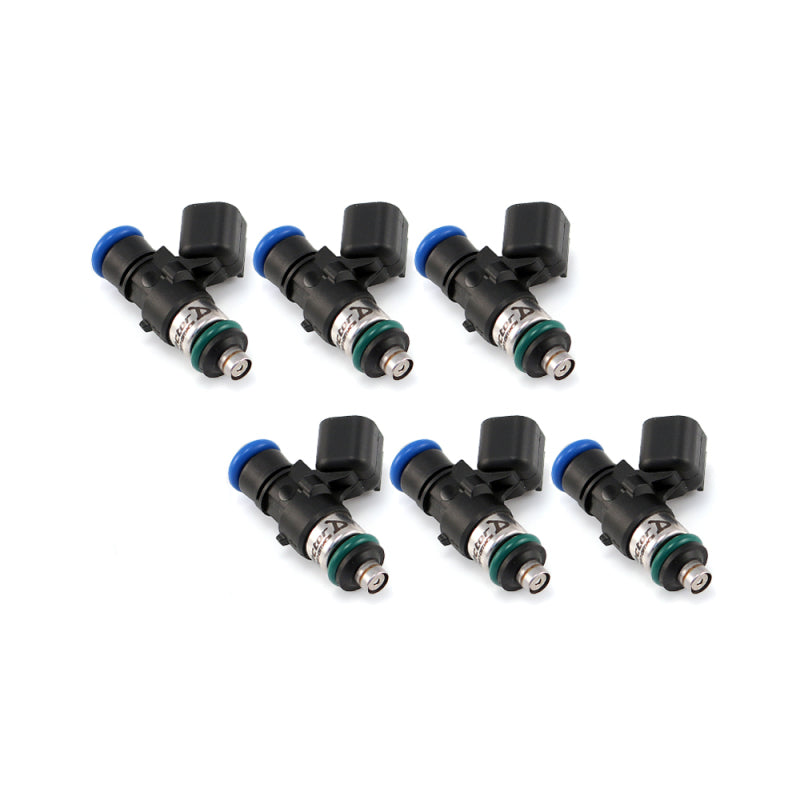
| Intake / fuel | RK Autowerks Intake Manifold w/ ID 1050x injectors |
| Transmission | Stage 2 built |
| Tune | E80 fuel, 40 psi, lambda 0.85, 14° timing. Literal copy-paste between cars. |
One car at sea level (~96 ft elevation, 88°F cell, baro 30.21 inHg). One car at elevation (~4,000 ft elevation, 86°F cell, baro 26.02 inHg = roughly 8,800 ft density altitude on test day).
Same Dynojet model at both shops. Here's the graph:

SAE J1349 corrected dyno graph overlay of two identical B58TU customer cars, one at sea…
The difference is STARK. You can clearly see the blue line (car at elevation) trumping the other car. But here's what happens when you turn off corrections:

Uncorrected dyno graph of the same two B58TU customer cars, showing the actual measured…
Now that looks much better. A variance of ~28whp. Easily understandable given regular variations (3-5%) in dyno cells.
Here's a summary of the differences:
| Correction | Sea Level Car | Altitude Car | "Difference" |
|---|---|---|---|
| Uncorrected | 834.0 whp | 862.9 whp | +29 whp (+3.5%) |
| SAE J1349 | 821.4 whp | 1,009.2 whp | +187.8 whp (+22.9%) |
| STD | 842.6 whp | 1,010.0 whp | +167.4 whp (+19.9%) |
What are dyno correction factors?
Dyno correction factors are just calculated factors to multiply the raw power output of a car to account for atmospheric conditions. There's quite a few, but most commonly you will see shops use STD and SAE corrections. Both corrections take your actual rolled number (what would be displayed if the run showed the "Uncorrected" numbers) and try to "normalize" it to a standard atmosphere. They use different reference conditions and slightly different math, but on a turbo car they're both wrong for the same reason.
SAE J1349 references 25°C (77°F) and 99 kPa dry. It includes a friction multiplier:
Where Pd is dry barometric pressure in kPa and Td is dry-bulb temp in Kelvin. Source: SAE J1349 standard.
STD is the older standard. References 77°F and 29.92 inHg. Pure atmospheric ratio, no friction multiplier:
Where Pd is dry barometric pressure in inHg and T is dry-bulb temp in Rankine (°F + 459.67). Reference conditions per Dynojet's published STD spec: 77°F, 29.92 inHg, 0% RH.
Plug in real numbers from both pulls:
Sea level car (88°F, 30.21 inHg, 21% RH):
- SAE CF = 1.176 × (99 / 101.35) × √(304.6 / 298) − 0.176 = 0.98
- STD CF = (29.92 / 30.07) × √(547.67 / 537) = 1.01
- Either way, the dyno barely corrects - conditions are already close to standard. The corrected and uncorrected numbers are within 1-2% of each other.
Altitude car (86°F, 26.02 inHg, 20% RH):
- SAE CF = 1.176 × (99 / 87.27) × √(303.15 / 298) − 0.176 = 1.17
- STD CF = (29.92 / 25.90) × √(545.67 / 537) = 1.17
- Both standards add 17% to the uncorrected number to "estimate" sea-level power. SAE and STD essentially agree at altitude.
So the dyno took the altitude car's 862.9 whp, multiplied by 1.17, and printed 1,009 whp. The math is correct. The math is also completely irrelevant to your turbo car.
Why this is bullshit on a turbo car
SAE J1349 was written for naturally aspirated engines. NA engines breathe atmospheric air directly. When ambient pressure drops 17% at elevation, an NA engine genuinely loses 17% of its mass per intake stroke, and 17% less air = 17% less power. The correction "refunds" that loss to estimate sea-level performance. That's legit for an NA car.
Turbo engines don't lose 17% to thin air. As mentioned in my DA article, turbos were literally designed to help aircraft engines perform at altitude. The entire initial purpose was to counteract the effects of altitude. The compressor doesn't care what's coming in - it just spins faster to hit your target manifold pressure. Your wastegate is targeting a specific boost number, not a percentage of atmosphere.
Pull the DME logs from both cars at peak HP and look at the actual operating data:
| Channel at peak HP | Sea Level Car | Altitude Car |
|---|---|---|
| Cell ambient pressure | 14.83 psia | 12.78 psia |
| MAP at peak | 54.33 psia | 53.86 psia |
| Compressor pressure ratio | 3.66 | 4.21 |
| Post-IC manifold IAT | 82°F (locked all pull) | 93°F (locked all pull) |
| Lambda | 0.853 | 0.846 |
| Timing | 14.0° | 14.0° |
| Cylinder fill | ~270% | ~270% |
| Manifold air density | 0.2706 lb/ft³ | 0.2628 lb/ft³ |
Same MAP within half a psi. Same lambda. Same timing. Same cylinder fill. Same fuel.
The only meaningful difference: manifold air density at altitude was 2.9% lower than at sea level. That's the entire altitude tax on a properly built turbo car. Not 17%. Two point nine percent.
The Turbosmart 6870's compressor walked from about 73% efficiency at sea level to about 70% at altitude (3 efficiency points off peak). It dumped maybe 60°F more heat into the charge to make the same gauge boost. But that's fine, because we have intercooled cars, so that means nothing to us. The integrated RK Autowerks A2W intercooler kept IATs steady and close to ambient.

DME log of post-intercooler manifold IAT across both pulls, locked at 82°F sea level vs…
OK but why does the altitude car read HIGHER uncorrected?
Because every dyno on Earth has variance, and that variance is bigger than people realize. Three things contribute:
1. Cross-dyno calibration variance (±3-5%)
Two Dynojets at two different shops will not read the same engine identically. Drum coast-down calibration drifts with age and so calibration recency naturally differs. Bearings wear. Some dynos sit in conditioned rooms, some sit in barns. Same model dyno, two installations, you'll see 3-5% spread on the exact same engine. That's 25-40 HP on an 850 HP car before you even start.
2. Loss of traction on the roller
Age of the dyno also matters. Dynojets in particular ship with a knurling on the roller surface. Over the years and thousands and thousands of dyno runs, this wears down, which introduces more slip on one dyno vs another. I cite sources and studies on this in my other article comparing different dynos, but it's anywhere from 5-10% depending on the power level and the wear on the roller. Even if you think it's not spinning, it's still spinning.

Customer car wheel and tire strapped down on Racebox Dynojet rollers showing the…
3. Cell air, airflow, ambient conditions
Engine dynos work best with cool, well-ventilated cells. Hot ambient air, recirculated exhaust, poor airflow over the intake - all of it costs measured power. A shop with a big bay door open and a fan blowing across the inlet will read different than a sealed-room dyno running off the building HVAC with dedicated flow matched inlets and oulets. And across days or seasons in the same cell, the temperature and humidity swing can dwarf this whole 5% on a turbo car. I broke that down in the DA breakdown.
So the 5% variance is real but marginal vs the 25% correction lie
Add up the dyno-side variables: maybe 5% spread between two installations. That's the noise floor for cross-dyno comparisons.
Compared to a 17% SAE correction at altitude, or a 22% gap between corrected numbers from two different dynos. The dyno noise is ±5%. The correction-factor lie is +25%.
And uncorrected isn't a magic answer either
While in this specific case, uncorrected was much more accurate, it's not always the case. While temperature is a smaller component of the factor, it is still taken into account. And this is where the second lie comes from: when shops present uncorrected numbers in the winter and claim it actually "makes more" if a correction factor was applied.
Cold temperature will always bring the correction factor down. If you're at sea level and it's 20 degrees outside vs 85, here's what it looks like:
85°F day at sea level (29.92 inHg, 50% RH → Pd ≈ 29.31 inHg / 99.3 kPa):
- SAE CF = 1.176 × (99 / 99.3) × √(302.6 / 298) − 0.176 = 1.01
- STD CF = (29.92 / 29.31) × √(544.7 / 537) = 1.03
20°F day at sea level (29.92 inHg, 50% RH → Pd ≈ 29.87 inHg / 101.1 kPa):
- SAE CF = 1.176 × (99 / 101.1) × √(266.5 / 298) − 0.176 = 0.91
- STD CF = (29.92 / 29.87) × √(479.7 / 537) = 0.95
Roll an 800whp uncorrected pull on that 20°F day. SAE-corrected, it's 728 whp. The cold dense air made the engine breathe better, and the correction factor brings that back to standard 77°F. The shop posting the 800 number with "imagine what this would be corrected!!" is lying. Corrected would be lower, not higher. The 800 is the inflated number, the 728 is the normalized one.
Shop's up north LOVE posting pulls in the winter and claiming they're oh so honest because it's uncorrected. They're not being honest, just trying to sell you more snake oil, as always.
So uncorrected, by itself, is also misleading if you don't know the conditions.
What you actually need to compare dyno numbers
For a dyno number to mean ANYTHING, you need three things:
- Ambient conditions plainly listed. Cell temp, baro, humidity. If the run data doesn't include conditions (where the peak numbers are shown) then they're hiding something
- Correction factor disclosed. If your tuner or your dyno graph doesn't show what CF was applied (or if uncorrected, that's stated) then you can assume it's bullshit.
- A baseline on the same dyno. The most important dyno comparison is BEFORE and AFTER on the same dyno, same conditions, same tire setup, ideally the same day. So even if they're playing with correction factors, the delta gain is still a reasonable check.
The bottom line
Two basically identical Turbosmart 6870 builds, on two installations of the same model dyno, made essentially the same engine power. Within all measurement noise, they were the same car. The dyno graphs said one was 188 HP stronger. It wasn't.
Next time you see "1,200whp at altitude" on Instagram, do the math. Pull 17% off for the correction factor fabrication on a turbo car. Pull another 5% for tire setup. Pull another 5% for whichever dyno is feeling generous that day. You're probably looking at a 950-1,000whp engine. Still a very fast car, but not as fast as they want you to think.
The questions to ask any shop posting power numbers:
- What does it run uncorrected, with conditions disclosed?
- What was the baseline on this same dyno, same setup?
- What dyno?
That's it. Anything else is marketing.
This is what we do at Racebox. We dyno-tune cars on our Dynojet, we always show conditions, and we baseline before/after on the same dyno. No dyno queens here. If you want a real number on your B58, S58, or VR30 build, come see us for an honest BMW or Infiniti tune.