The Definitive Guide to BMW B58 & S58 Maintenance
If you're reading this, you own a BMW with a B58 or S58 engine. You also probably want to make it faster while keeping it alive. Good! You're in the right place.
The B58 and S58 are, without question, BMW's best modern inline-6 engines. The B58 (in both generations) powers every 40i car from the 340i and M340i to the Supra, while the S58 sits in the M2, M3, M4, X3M, and X4M. These are genuinely great engines from the factory, and they respond incredibly well to modifications. So well, in fact, that it's hard to find a used one that hasn't been modified, which is exactly why you need to take maintenance seriously.
Here at Racebox, we've tuned hundreds of B58 and S58 powered BMWs. We've built transmissions, diagnosed failures, and seen what kills these engines and what keeps them running for 100k+ miles under heavy use. We put this guide together based on that real-world experience over our years in business - not forum speculation and YouTube comment sections. All three engines (B58 Gen1, B58TU, AND S58) are covered in one guide because they share core architecture, but we'll call out the differences where they matter. And trust us, some of those differences matter a lot.
Whether you daily your M340i or track your G82 M4, staying on top of maintenance is what separates a reliable build from a headache. So bookmark this page. This is THE comprehensive B58 and S58 maintenance guide, built from years of hands-on experience tuning and wrenching on these cars.
Or if you have a short attention span, just look at the chart below. For those that care to know our reasoning, read on!

The Racebox B58/S58 Maintenance Schedule
| Item | Stock Interval | Tuned Interval | Notes |
|---|---|---|---|
| Oil Change | 5,000 miles | 5,000 miles (pump gas) / 3,000 miles (ethanol) | 5W-30, fully synthetic |
| Spark Plugs | 50,000 miles | 20,000 miles (stock turbo) / 10,000 miles (big turbo) | Gen1: NGK 94201 / B58TU & S58: NGK 93560 |
| Transmission Fluid | 50,000 miles | 10,000 miles (600+whp or built trans) | ZF 8-speed, Motul ATF VI recommended |
| Differential Fluid | 20,000 miles | 20,000 miles | Replace front and rear differential fluid |
| Transfer Case Fluid | 20,000 miles | 20,000 miles | AWD (xDrive) vehicles only |
| Coolant | Inspect every oil change | Replace every 40,000 miles | Check expansion tank for cracks |
| Drive Belt | Inspect every oil change | Inspect every oil change | Visual inspection for wear/cracking |
This table covers the recommended intervals for most customers. If you're running ethanol blends, doing heavy track days, or have a built motor, read the full guide below for a more detailed breakdown.
This B58 and S58 maintenance schedule is based on our experience tuning and servicing hundreds of these cars. Now let's get into the details.
Importance of Data-Logging

This wouldn't be a guide by Racebox if we didn't stress the importance of data-logging. If you're modifying your B58 or S58, you need to be logging. Period. Luckily, these engines have excellent data-logging support through both MHD and EcuTek. With either platform, you have access to nearly every critical engine parameter at high logging rates. This means you can keep tabs on temperatures, pressures, ignition events, and more.
A few key things we tell all of our tuning customers: never exceed 3,000 RPM until oil temperature is AT LEAST 170°F, always run quality fuel, never let the car run too hot, and watch your charge air temperatures. 99% of problems can be caught early by frequently monitoring your engine's vitals. Watch idle oil pressure (should always be 30+ psi) and WOT oil pressure (70+ psi for B58, 80+ psi for S58). These engines rarely have oil pressure issues, but when they do, catching it early is the difference between a repair and a rebuild. Make it a habit to scan DTCs once a week, as many are silent codes that don't throw a check engine light or even a limp mode/drivetrain malfunction (DTM).
Get with your tuner to establish a dashboard of critical monitors. If you're running MHD, you can pick up a MHD Super License through us. If you're already tuned by us, then you're well equipped - we build our custom datalog parameter list right into our tuning workflow.
Common Issues on the B58 and S58
This wouldn't be a comprehensive guide if we didn't go over the major pain points. The B58 and S58 are far more robust than the internet would have you believe, but they do have their quirks. In our experience, these are the top issues we see:
-
Leaky direct injectors - primarily B58 Gen 1 but happens on TU and S58s as well
- Oil filter housing gasket leaks - primarily B58 Gen 1, can appear as early as 40k miles
- Plastic oil pump failure - early B58TU (2018-2020 production)
- PCV / valve cover failures - B58TU and S58 have integrated PCV in the valve cover
- Eccentric shaft and sprocket wear - high mileage B58 Gen 1 and some S58
- Crankcase pressure management - critical on any boosted build making real power
Through the rest of this guide we'll address each of these and how you can prevent them or spot them early.
BMW B58 & S58 Oil Changes

This is the most fundamental thing you can do for your engine, and the easiest to get right. While BMW's recommended oil change interval through their Condition Based Service (CBS) system often stretches past 10,000 miles, we at Racebox recommend a 5,000 mile oil change interval (OCI) on pump gas whether you are stock or tuned, daily or track car.
If you're running ethanol blends that interval drops to 3,000 miles max and you better have a proper flex fuel kit (the MHD CAN Flex Fuel Kit is fantastic) to know exactly what's in your tank! Ethanol dilutes engine oil significantly faster than gasoline. And remember, pump E85 is inconsistent - winter blends can be as low as E50. Ethanol doesn't vaporize as easily as gasoline, so it accumulates in the crankcase and breaks down the oil's viscosity and protective properties much faster. This also leads to excessive fuel getting by the piston rings, eventually mixing into the oil. If you're on E30+ and pushing past 3,000 miles on the same oil, you're gambling with your bearings. For dedicated race cars that only come out for events and are driven hard every time, consider 1,500-2,000 mile intervals regardless of fuel type.
For viscosity, our recommendation is straightforward: 5W-30 for most cars. The B58 and S58 were designed around this viscosity. These are closed-deck engines with tight tolerances and they don't need you overthinking the oil weight. If you have a built motor, follow your engine builder's recommendation - they know the clearances they set.
The one exception: if you're doing heavy circuit racing with sustained oil temperatures at 240°F+, you should be running a thicker oil like 5W-40. At those sustained temperatures, 5W-30 shears down and loses its protective film strength. We tune several dedicated time attack Supras - including the Prodigy Apparel and Rigo Built cars - and they all run 5W-40 for exactly this reason. If your car sees regular, sustained track abuse, do the same.
As for brand, run fully synthetic from any major manufacturer. We personally prefer Motul and Liqui Moly on our cars, but Mobil 1, Castrol, Penzoil Ultra Platinum - they're all fine. Don't overthink it. Just change it on time.
One thing worth mentioning: if you have an early B58TU (2018-2020 production), be aware of the plastic oil pump carrier issue. These early B58TU engines shipped with a plastic oil pump that is prone to failure, which can result in catastrophic oil pressure loss. BMW revised this to an all-metal design (part number 11419895359) around 2021. If your car falls in this production window and you haven't confirmed the pump has been updated, it's worth checking. This is the kind of thing that kills engines silently, especially if you're not monitoring oil pressure.
Which brings up our next point: monitor your oil pressure! Idle should be 30+ psi and WOT should be 70+ psi (80+ for S58). These engines rarely have oil pressure issues since the oiling system is robust. But if you see pressure dropping below these numbers, something is wrong and you need to investigate immediately.
Best Spark Plugs for B58 & S58

If you ask your BMW dealer about spark plugs, they'll tell you they're good for 100,000+ miles. And on a bone stock car driven gently, that might be true. But if you're reading this guide, you're probably not driving gently.
Here's what we recommend:
- Stock car: Replace every 50,000 miles
- Tuned, stock turbo: Replace every 20,000 miles
- Big turbo builds: Replace every 15,000 miles
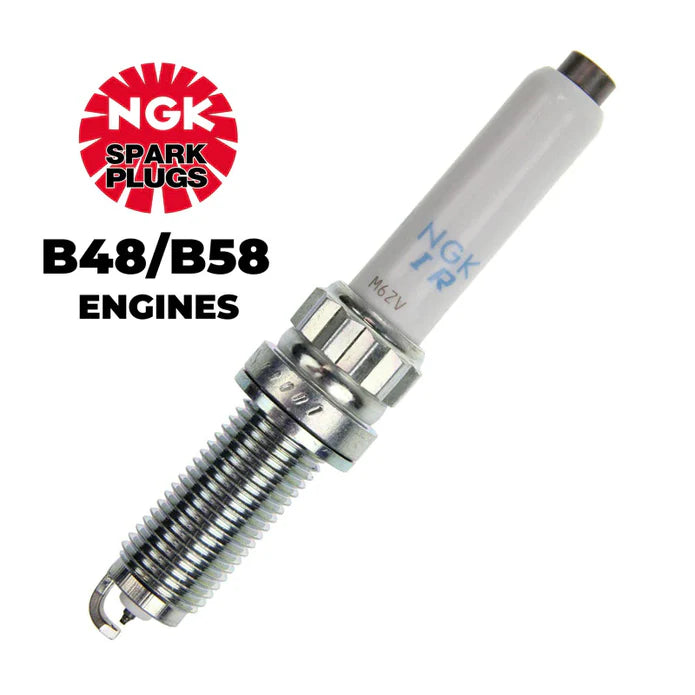
For the B58 Gen 1 (N55 successor found in F-series 340i, 440i, 240i, etc.), we recommend the NGK 94201 (SILZKGR8B8S). These are the correct laser iridium plug for the Gen 1 platform.
For B58TU and S58 (G-series M340i, M240i, M3, M4, M2, X3M, X4M, etc.), we recommend the NGK 93560 (SILKGR9A7ES). This is one step colder than the stock heat range (heat range 9 versus the stock heat range 8). The colder plug is better suited for tuned applications and higher boost levels.
Keep plugs at the stock gap of 0.028". There's no need to close the gap on these platforms for most tuned applications. If you're running a big turbo setup, consult with your tuner as you may need to go tighter at very high boost levels. In our experience, we've only recommended a tighter gap on Gen 1 cars running 1kwhp+.
A couple of notes: stock coil packs are perfectly fine. You do not need to replace them when doing plugs unless one is actually failing. Don't waste your money on "upgraded" coils - the OEM units are more than adequate.
Frequently replacing your spark plugs ensures an optimal burn, reduces the chance of deposits or hot spots from incomplete combustion, and lowers the likelihood of a pre-detonation event that could damage your piston or cylinder wall.
B58 Gen 1 High Pressure Fuel Pump (HPFP)
This one is specifically for gen1 B58 owners. The stock gen1 high pressure fuel pump can run out of flow capacity even on a moderate 93 octane tune with downpipes. When the HPFP can't keep up, fuel pressure drops under load, and the car will let you know with a fat backfire and a bunch of misfire codes with a DTM. The first time can be quite scary, and we get calls about this sort of thing all the time when people blend too much ethanol, even on a TU.
The good news? The OEM B58TU high pressure fuel pump is a direct swap into the Gen 1 B58 and flows significantly more than the Gen 1 unit. It works perfectly fine on the stock tune with no recalibration needed, and it gives you the headroom you need for bolt-on power levels. This is one of those upgrades that we recommend for all B58 Gen 1 cars, even mildly tuned ones. It's cheap insurance and an easy install.

B58 Gen 1 Direct Injector Issues
This is a big one for B58 Gen 1 owners and something most people don't think about until it's too late. The stock direct injectors are a known failure point. It's not always a catastrophic, blow-up-the-engine failure, but a slow, sneaky one that causes problems down the line if you're not watching for it.
Here's how to check: log your DI rail pressure when you shut the car off. After key-off, rail pressure should climb briefly and then hold steady, and then fall off after some time. If you see rail pressure immediately falling after shutdown, you have a leaky injector. It might not be throwing misfire codes or causing adverse drivability issues, but a slowly leaking injector will eventually fail and leave you with a misfire, or worse.
This is not as common on the B58TU and S58 - the injector design was improved on the newer platforms when the fuel system was upgraded to a 5000psi setup.
The fix isn't cheap since replacing injectors is more involved and more expensive than swapping a charge pipe. But catching it early is exactly the point. This is also a perfect example of why we recommend having MHD or EcuTek on your car even if you plan to stay on the stock tune. The logging capability alone is worth the cost of entry. You don't need a tune to benefit from being able to monitor rail pressure, oil pressure, boost, and temperatures. Think of it as a health monitor for your engine. Logging lets you catch things like a leaky injector before they turn into a rebuild. If you're not logging, you're flying blind.
B58 & S58 PCV, Valve Cover & Crankcase Pressure
This is where things get nuanced, because the B58 Gen 1, B58TU, and S58 all handle crankcase ventilation differently. Understanding these differences is critical if you're making real power.
B58 Gen 1

On the Gen 1 B58, the PCV system is partially integrated into the valve cover, but the diaphragm that fails is easily replaceable and cheap, so you don't need a whole new valve cover like you do on the B58TU. The bad news? That diaphragm can fail at any time, not just under high boost. There are plenty of documented cases of PCV diaphragm failure on bone stock Gen 1 cars just from extended idling. The combination of heat cycling and sustained vacuum at idle deteriorates the diaphragm over time, leading to excessive crankcase pressure, oil consumption, and codes.
For this reason, we recommend a PCV delete for most Gen 1 applications. The delete replaces the factory PCV cap and diaphragm with a cap that uses a barb fitting and ring to seal the PCV system. From there, you route crankcase ventilation to a proper catch can. It's a clean, permanent solution that eliminates the failure-prone diaphragm entirely while still managing crankcase pressure correctly.
If you'd rather keep the PCV system intact, check valves are the modern solution for preventing damage at high boost. The old-school approach was plugging the head ports entirely, which works but isn't easily reversible and can affect idle behavior. Check valves on the valve cover ports retain proper idle function while protecting the diaphragm from boost pressure spikes. It's a cleaner, more reversible solution.
For catch cans, BMR makes excellent options for the B58TU and S58. For the Gen 1, we're currently working directly with BMR on a solution that incorporates the PCV delete into a complete catch can kit. In the meantime, a PCV delete with any quality catch can and proper plumbing will get the job done.

B58TU
The B58TU is a different story. BMW integrated the PCV directly into the plastic valve cover. When the PCV fails, you need to replace the entire valve cover. Symptoms include excessive crankcase pressure, oil smoke from the exhaust, and in some cases, cracked valve covers from the pressure buildup. This is one of the more frustrating design decisions BMW made on the B58TU.
The good news is that Visconti Tuning offers an upgraded valve cover modification for the B58TU. They can either modify your existing cover or sell you a new upgraded unit that addresses the PCV failure issue. For any tuned B58TU, we recommend both a BMR catch can AND the Visconti valve cover upgrade. It's cheap insurance against a problem that will eventually find you if you're making power.
S58
The S58 shares the same integrated PCV design as the B58TU, the PCV is built into the valve cover. However, in our experience, we've rarely seen failures on stock S58 valve covers compared to the B58TU. The S58 seems to handle it better, likely due to differences in crankcase pressure management from the factory. That said, we still recommend a BMR catch can as a preventive measure on all S58 cars. Visconti also offers an S58 version of their upgraded valve cover, but it's less critical than on the B58TU unless you're pushing serious power.
B58 Gen 1 Oil Filter Housing Gasket
This is a well-known issue on the Gen 1 B58. In fact, that there is a class action lawsuit over it. The oil filter housing on the Gen 1 uses a plastic housing that becomes brittle from heat cycling over time. The gasket deteriorates and the housing itself can crack, leading to oil leaks. We've seen this appear as early as 40,000 miles.
Aftermarket aluminum oil filter housing gasket (OFHG) upgrades exist and are the permanent fix. If yours is showing any signs of oil seepage around the filter housing, address it sooner rather than later. A small leak turns into a big one, and you don't want to wait until something catastrophic happens.
The good news: in our experience, the B58TU and S58 do NOT suffer from this issue. BMW appears to have addressed the housing design on the newer platforms.
B58 & S58 Eccentric Shaft & Valvetronic
On high-mileage B58 Gen 1 and S58 engines, the eccentric shaft sprocket in the Valvetronic system wears down over time. This is a slow-developing issue, but it's one to be aware of as your car accumulates miles. If you start getting Valvetronic or VANOS fault codes, the eccentric shaft sprocket is a likely culprit.
We've confirmed this firsthand when installing built motors. We'll start it up and get immediate codes, and the car will fail to accept a re-learn from ISTA. When pulling the eccentric shaft, the wear is clearly visible on the sprocket teeth. It's enough that when the motor is put back together, it's just off by enough that the system won't accept it.
There's no preventive maintenance for this one other than monitoring for codes and addressing it proactively on higher-mileage cars. If you're doing an engine build anyway, replace the eccentric shaft and sprocket while you're in there.
ZF 8-Speed Transmission Maintenance
The ZF 8HP is found behind virtually every B58 and S58 car and it's a fantastic transmission. But like any automatic, it needs fluid, and that fluid breaks down faster when you're putting more power through it and driving hard.
Our recommendations:
- Stock or mildly tuned: Replace transmission fluid every 50,000 miles
- 600+ whp or built transmissions: Replace every 20,000 miles
We recommend Motul ATF VI fluid. For the fill procedure, OEM spec calls for warming the fluid to 40–50°C, then filling until it weeps from the fill hole with the engine running. That's the baseline.
However, Racebox and other performance shops additionally recommend the tilt overfill method for cars that are driven hard. Jack the passenger side of the car up 30–40 degrees. This allows the fluid to shift away from the fill hole, opening up capacity. Fill again until it weeps from the fill hole. Set the car back down and repeat. This gets maximum fluid into the transmission for better clutch pack lubrication under hard use, heavy loads, and repeated launches. If you're pushing real power through a ZF 8-speed, the extra fluid makes a noticeable difference in shift quality and longevity.
Symptoms of old or degraded transmission fluid include: flaring on shifts (RPMs spike between gears), lazy shifting during daily driving, and harsh shifts as the TCU bumps up line pressure to compensate for slippage. If you're experiencing any of these, a fluid change is the first thing to try.
B58 & S58 Charge Cooling (IATs)
The B58 and S58 both use air-to-water (A2W) charge cooling systems, similar to many modern cars. The S58 has fantastic stock cooling, but the B58s (both generations) need an intake manifold upgrade at anything above stock turbo power levels. Definitely look into an upgrade if you're going the upgraded turbo path.
As far as fluids, we recommend replacing coolant every 40,000 miles. Use BMW-spec coolant (or equivalent) and make sure the system is properly bled after any coolant work. Air pockets in the cooling system are the enemy and can be hard to work out. Make sure to follow OEM bleed procedures.
Keep an eye on charge air temperatures when logging. If you're seeing temps climbing higher than they should, you might have a bubble in the system.

Conclusion
The B58 and S58 are excellent engines. They respond incredibly well to mods. From a simple flash tune to full big turbo builds, these platforms deliver. The closed-deck design, forged crank, and robust bottom end give you a solid foundation to build on. With proper maintenance and consistent monitoring, these engines are reliable well beyond what internet forums and comment sections would have you believe.
We've tuned hundreds of B58 and S58 cars here at Racebox, and our customers who follow a proper maintenance schedule and stay on top of their logs rarely have issues. The ones who ignore maintenance and never log? Those are the ones you see posting about failures.
Don't be that person. Follow the schedule, log your car, and stay proactive.
If you're looking to get tuned or want to talk about your build, check out our tunes:
As always, if you have any questions, give us a shout. We hope this was helpful!